Digital Intelligence at Scale
Input any source, format, or language. Output structured, connected, auditable intelligence products.
For collections too large for teams to read and chatbots to hold: an intelligence platform that runs wherever the evidence does, with no server farm, no embedded engineers, and no cloud dependency.
Evidence In. Intelligence Out.
Ingest anything.
Files, websites, records, and enrichments: thousands of formats and languages, processed natively with no translation step. Seized media and disclosure sets, not just the open web.
Resolve every dot.
Extracted people, accounts, places, and identifiers become Intelligence Profiles; the same thing named in three different sources resolves to one profile carrying all three, before anyone connects dots.
Deliver defensible intelligence.
Graph, timeline, and map analysis over the whole corpus, with every conclusion traceable to the exact source sentence.
Minutes, not months. Runtime Level-of-Effort counters report the analyst man-hours replaced as the platform runs.
Built by People Who Have Done This Before
TR3AD is the fourth generation of intelligence software from a team whose systems have been fielded by US and international governments, commercial and critical-infrastructure organizations, and global NGOs, and are still running today.
Import Everything. Get Briefed.
Most tools process your data into pre-built screens and empty templates. TR3AD does something different: after you import your evidence and run enrichments, it drafts the intelligence products themselves: dashboards, reports, and storyboards designed and built to fit what your data actually contains. The analyst reviews, refines, and extends those drafts, then publishes the result, anywhere it needs to go. It doesn't wait for questions. It briefs the analyst first.
Dashboards
Drafted, not configured. Interactive, and coded from the graph's content rather than filled into a template.
Reports
Drafted from evidence. Multi-section, built from provenance content, with every statement traceable to its source sentence.
Storyboards
The narrative, assembled. Timelines, presentations, and narrative, generated from the graph and shaped by the analyst.
The analyst reviews, refines, and extends those drafts, then publishes them: a customized Intelligence Portal, documents and files, external systems and feeds, even other ontologies.
How products are drafted and publishedMore Data Than Anyone Can Read
In eDiscovery, forensics, DOMEX, and large-scale intelligence collection, the volume of material far exceeds what analysis teams can consume.
The figures below all describe one real collection, measured end to end.
That collection: 130,000 messages · 32,000 attachments · 73 million words · 8 languages.
The distance between the first figure and the last is the whole problem: roughly 1,000×, and widening every year.
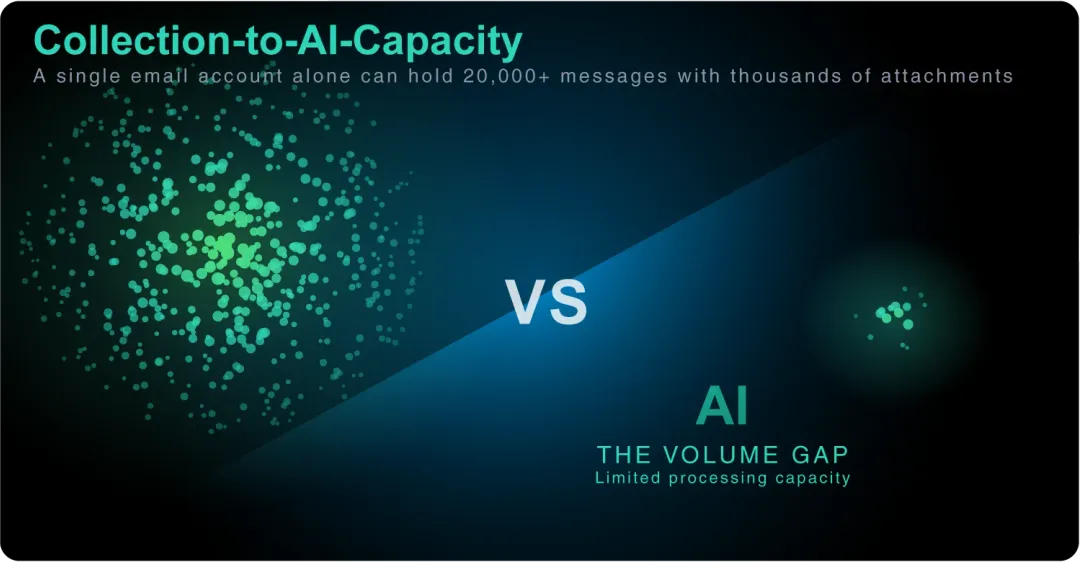
Mainstream AI tools don't close this gap; they hit it. Context ceilings force silent compression of everything the model read earlier, and silent compression is where hallucination starts. Summarization at volume doesn't eliminate the reading problem; it redistributes it, with bias applied uniformly across your entire organization. The answer isn't a bigger context window. It's structure between the raw data and the model.
Independent Processing, Connected Intelligence
Every resource processed independently
Each file, page, and record is analyzed concurrently in its own bounded AI session. That independence delivers AI at the scale of hundreds of thousands of resources.
A profile for every thing
Intelligence Profiles span entities (people, companies), devices (phones, computers, email addresses), and cyber (domains, IP addresses, software), across the entire domain.
Context resolution solves the "same dot" problem
The email address in one file, the sender in another, the account holder in a third: recognized as the same dot before anyone tries to connect the dots.
Less hallucination by design
No session ever silently compresses context, so the primary cause of AI hallucination is engineered out.
See It on Your Own Material
Demonstrations run on your data, in your environment, including fully offline.